
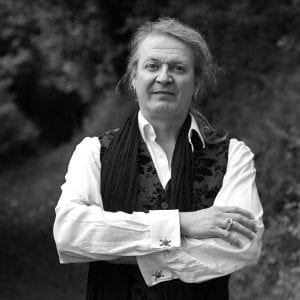
Prof. Nick Groom
University of Macau, China
Research Area:
1. cultural formation and authenticity, including attribution studies and literary forgery (especially the poet Thomas Chatterton);
2. national and regional identities (primarily UK, Irish, and Anglophone);
3. cultural environmentalism and intangible cultural heritage (ICH), including folklore and ‘green well-being’; and
4. historicist readings of the Gothic from earliest times to the present day – for which he is probably best known, especially in the media.
Title: What is Happening to the Gothic in the Age of Covid?
Abstract: Traditional Gothic imagery of death and ruin, ghosts and vampires, contagion and conspiracy theory has flourished in the Western media as ways of representing and imagining the threat and impact of the Covid-19 coronavirus. This is not new: Gothic superstition has mixed with medical science for centuries to try to explain epidemic infection, and vampires, for instance, have been seen as vectors of plague. Consequently, depictions of vampires have shadowed medical practice, embracing and assimilating new advances in bioscience, as well as becoming instrumental in theological, philosophical, and economic thought, and so even today the language of vampires and vampirology can cast a light on the contemporary experience of epidemic measures. Yet at the same time a new Gothic imagery is emerging based not around monstrosity but emphasizing the non-human and the unknown: the ‘weird’ and the ‘eerie’. The relationship between these two reformulations of the Gothic is as yet unpredictable, but it is likely to have long-lasting impact on literature and film, language and culture.

A. Prof. Chew Fong Peng
University of Malaya, Malaysia
Research Area: Malay Language Education, Malay Literature Education, Chinese Language Education, Education and Integration, Language in Culture and Society.
Title: Suitability of Literary Component Texts in the Malay Language at the Malaysian National Secondary Schools
Abstract: The literary component in Malay was first introduced in all national secondary schools in Malaysia in 2000. Students are required to study all literary genres including traditional prose, traditional poetry, short stories, novels, dramas, and modern poetry. All literary genres are contained in an anthology for each form except novels. The selected novels are based on four zones, namely Zone One (Perlis, Kedah, Penang, Perak), Zone Two (Selangor, Negeri Sembilan, Kuala Lumpur, Putrajaya), Zone Three (Johor, Sabah, Sarawak, WP Labuan) , and Zone Four (Kelantan, Terengganu, Pahang, Melaka). This speech will analyze the suitability of the selected novel texts for Forms I to Form V of the current syllabus based on zones. In addition, the discussion is also given on the literary anthologies from Form I to Form V.

A. Prof. Wang Zaojuan
Northwest University/Chinese Culture Research Center, China
Research Area: Literature and culture of Tang Dynasty,Religious literature.
Title: Ecological civilization and new approaches to the study of Tang poetry
Abstract: Ancient Chinese literature contains a lot of content related to ecological culture, which reflects China's understanding of harmony between man and nature, Man and man, Man and society since ancient times, the study of Chinese classical literature can make an important contribution to the construction of ecological civilization. The modern society's concern for ecological civilization leads to the concept of ecological literature. A modern perspective on Tang literature can provide a new research horizon. This field of vision includes: First, deepen and expansion of the research content. The research content will be extended to animal writing, water writing, philological writing and ecological imagination, and more related to ecological information fields. Combined with historical records, scientific and technological means were adopted to restore the ecological landscape of the relevant regions. Second, transformation study vision. to pay attention to the ecological characteristics of different regions and the formation of ecological thought, and to the interaction and exchange of ecological phenomena and ecological thought in different regions, the identity, social and cultural reasons for the formation of ecological expression of different individuals. Third, on the basis of the aesthetic concepts formed in history, such as“Blending of feeling and scene”, “Subject and object”, “Harmony”, “Conflict” and“Loftiness”(religious ecology) , reaches can further expounds its aesthetic connotation, historical and contemporary significance. Fourth, to construct the ecological culture research system of the literature of Tang dynasty. It is an important link to construct the ecological culture system of Chinese. The scholars of Tang dynasty literature can take the study of Tang Dynasty poetry as the center, and form a multi-level research system of ecological culture, such as the study of author, the study of style, the study of cultural exchange and the study of aesthetics.

A. Prof. Wang Lin
School of Foreign Languages, Northwestern Polytechnical University, China
Research Area: German history after World War II, culture history and culture memory.
Title: The friction and conflict between film art and politics--- The Path of Film Development in the GDR (1946-1990)
Abstract: Since the appearance of expressionism films in the 20s last century, Germany has been recognized as one of the leading countries with strong film tradition. While the film market of West Germany had gradually become the dump object of the western countries such as the USA, East German filmmaker still held the ground of their own film industry in spite of the secession and the affects from the state’s policy. Seen from both the antifascist-themed films in early stage and the realism-themed films in later stage, the development of East German films marks the era. This is worthy studying to help people know about the political and culture life in East Germany although it doesn’t still exit.
Key words: East German politics, history of East German films, antifascist themed film, Berlins film; film about life